
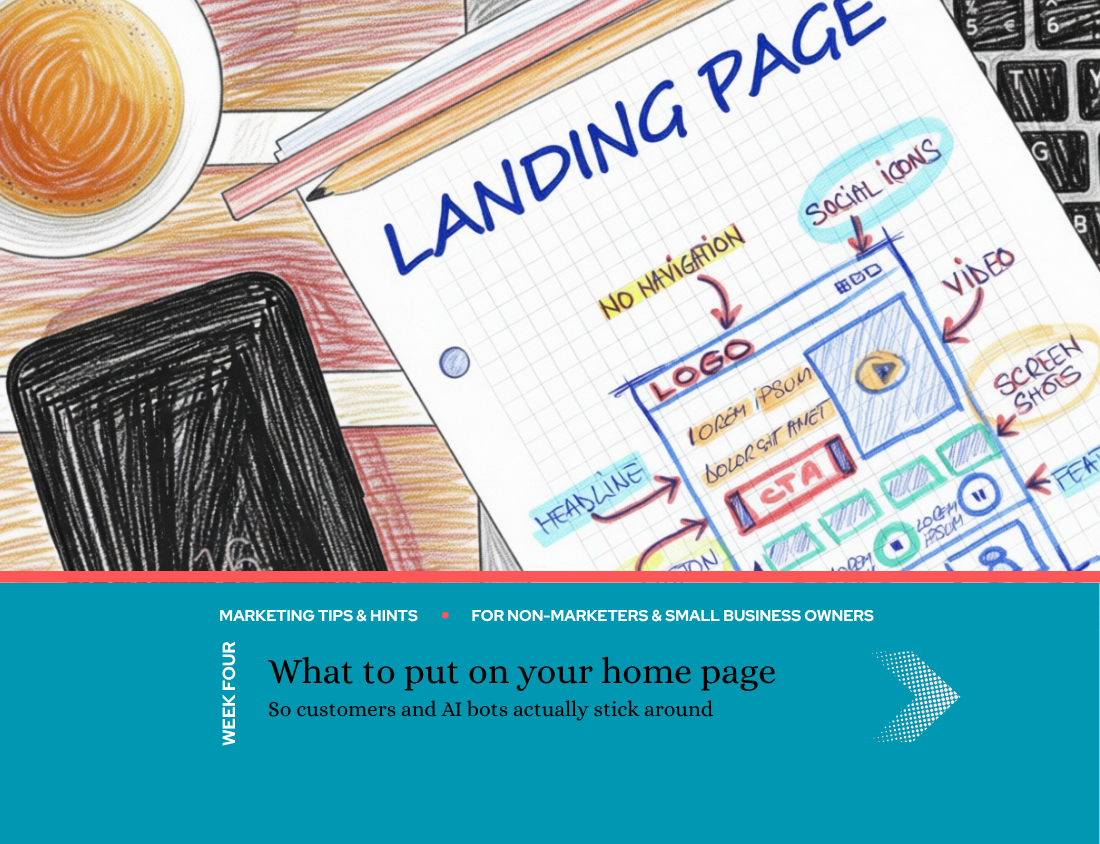
Week Four: Homepage Content Checklist for Small Business Websites
Your homepage has about 50 milliseconds to make a first impression — before anyone's read a single word. Here's exactly what needs to be on it: the photos, the words, and the bits AI search bots are quietly checking for too, plus a free checklist to work through it yourself.
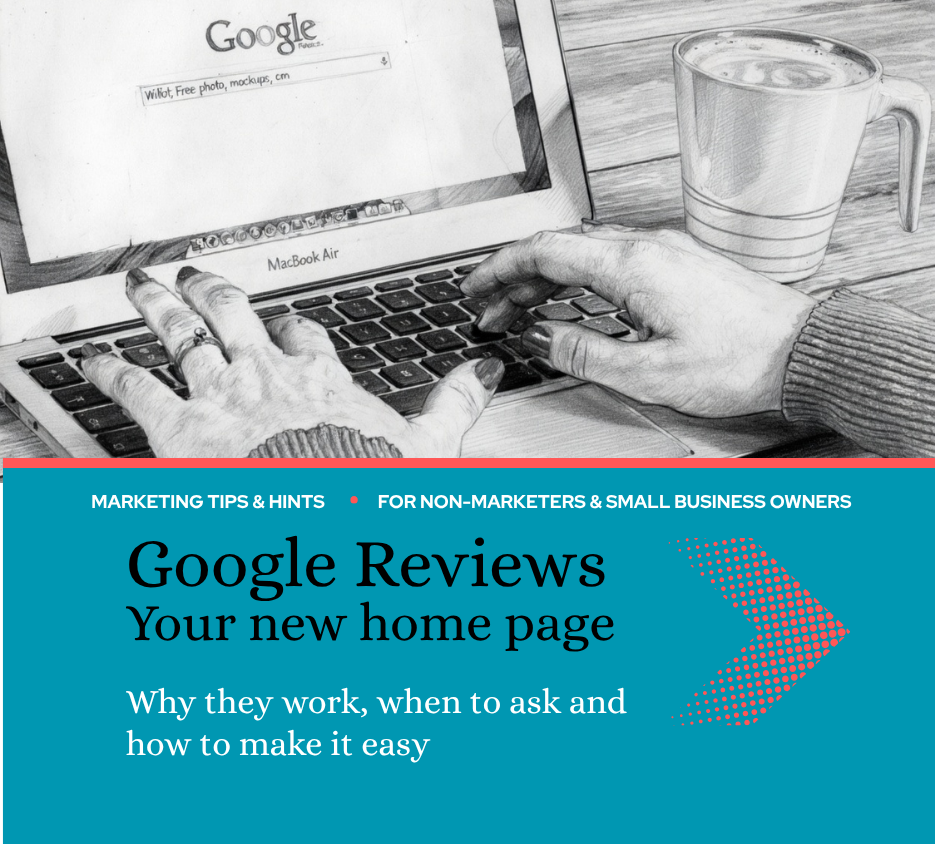
Week Two: Reviews are your new home page
83% of Kiwis check Google reviews before choosing a local business — but most owners never ask for one. This week's A Bit More breaks down exactly how: where to find your review link, word-for-word scripts for asking, the right timing, and how to handle a bad review without losing sleep over it.
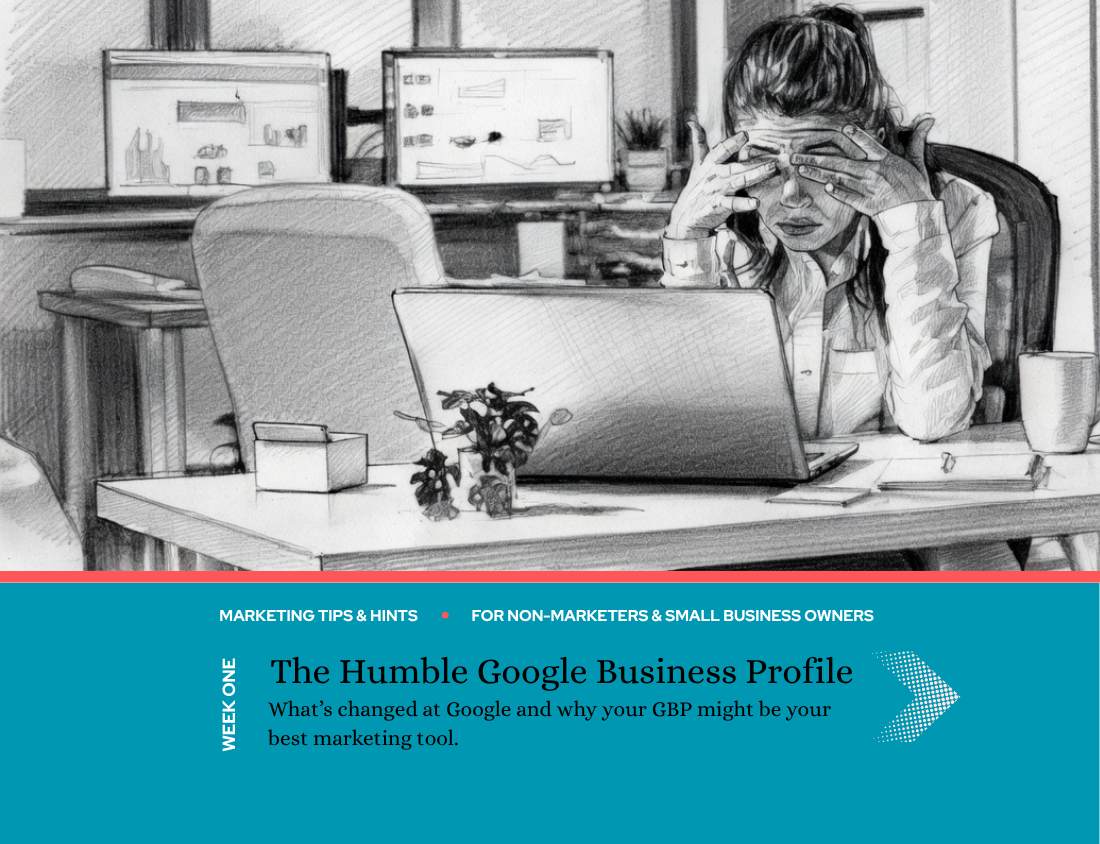
Week One: The Humble Google Business Profile
Google can now search, recommend and even book on a customer's behalf – no website visit required. Here's what that shift means for your business, plus week one of a new series: getting your free Google Business Profile actually working for you.
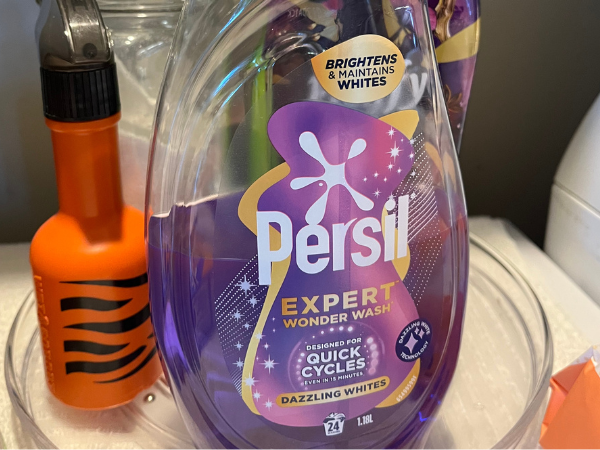
Laundry, late fees, and a lesson in customer power
Sunday nights used to mean one thing at our place: a mountain of clean laundry dumped on the lounge floor, and all of us rifling through it looking for our own socks. 😅
These days my laundry pile's a lot smaller (thank goodness), and I've upgraded to the "fancy" wash cycles — including Persil's quick-cycle option. And look, it's probably just clever packaging around the same formulation... but it feels like I'm saving on power. And that feeling? That's smart marketing.
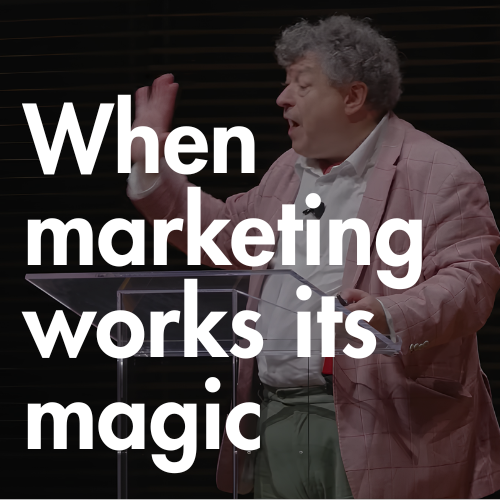
When marketing works its magic
As a marketer, I keep a close eye on the thinkers who genuinely move the needle, and Rory Sutherland is right at the top of that list. As Ogilvy's vice chairman, he's spent decades proving that the most rational marketing decision often isn't the best one — and that the real growth opportunities are usually hiding in plain sight, dismissed as "too obvious" or "doesn't make sense on paper." For Northland business owners chasing growth, this is a masterclass in the craft of marketing: how understanding customer psychology, not just logic, is what actually moves the needle.
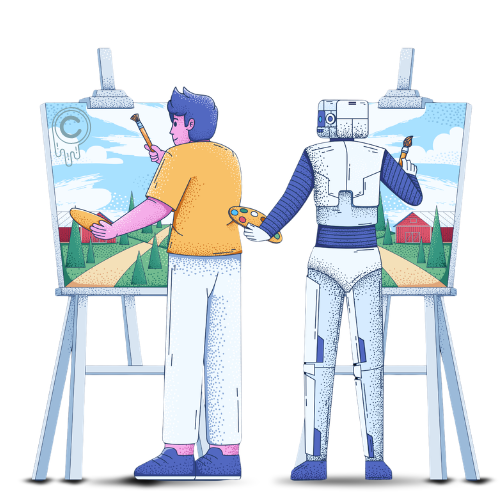
Did AI just nick some else’s work and put your name on it?
It's 6.15pm, your newsletter's overdue, and AI whips up a gorgeous image and a tidy paragraph in seconds. Magic! Mostly. But AI got that clever by quietly borrowing millions of other people's words, photos and designs — so every now and then it hands you something that isn't actually yours to use. And it's not just a big-brand problem. Accountants, retirement villages, builders or any business owner can all land in hot water without meaning to. The good news? It just takes a little checking.

We've All Had Those Days — and Why the Bad Ones Are Worth Keeping
We've all had those days — let's be honest, sometimes whole weeks or months — when you'd give anything for a 'do-over'. Maybe a piece of software has pushed you to the edge, a mistake slipped through on a job, a client walked, or someone decided to be thoroughly stroppy that day. It's the hard stuff that comes with running a business: the bits you have to face, make peace with and, with any luck, learn something from.
Lately, my own do-over has been about time — hours sunk into trialling shiny new technology that ultimately led nowhere. In the AI era, with something new to test every other week, it's a trap we all need to watch for. So I've made myself a rule, and I'll share it here.
I'll also let you in on my slightly petty secret for surviving a rough day, and a surprisingly powerful exercise we tried at a recent networking group: what would you tell yourself a year ago? It's a good one for taking stock of how far you've come — and deciding where you're headed next.
Have a read, and see what resonates.
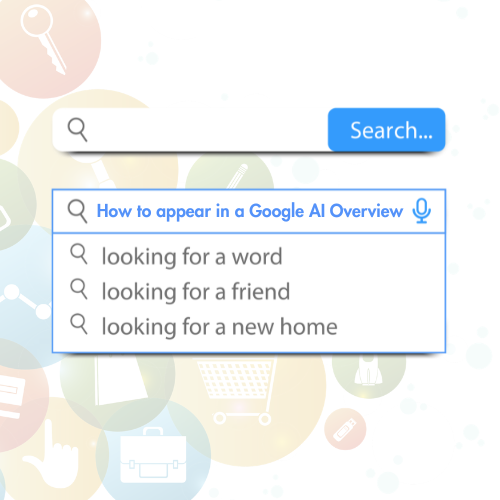
Two Questions Every Business Owner is Asking about Google AI
Two questions are on the minds of business owners in 2026: how do you get your business into a Google AI Overview, and how do you control what it says about you? The good news is the answer is simpler than the hype suggests. Here's the plain-English version — what actually matters, what to ignore, and the one quick email you can send today.
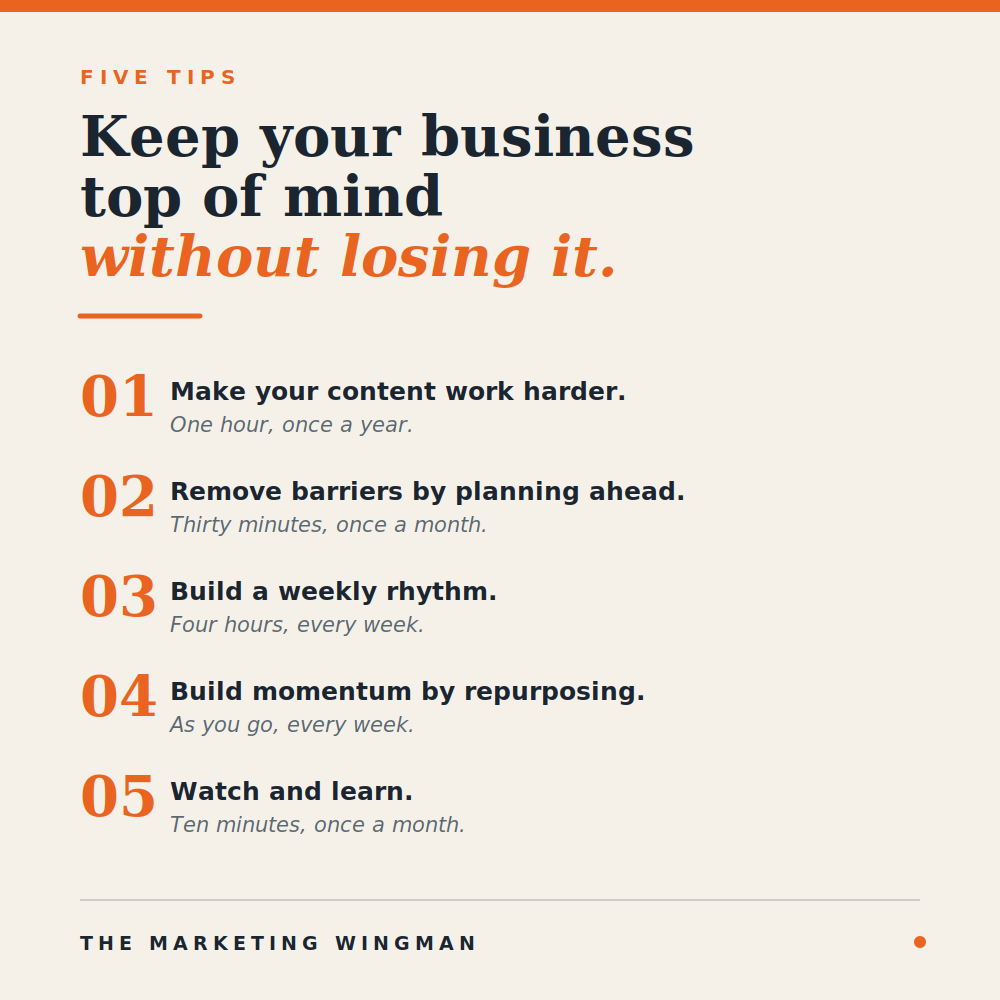
How to keep your business top-of-mind without losing your mind
Ever scrolled through your phone in the evening and felt that pang of envy at a competitor's polished posts and helpful resources? That used to be me too. The truth is, consistent marketing doesn't come from inspiration or willpower – it comes from systems. Drawing on James Clear's Atomic Habits, this blog shares five small, repeatable habits that will keep your business top of mind without consuming your week. From annual foundation messages to a weekly content rhythm, each tip is designed to make marketing feel less like another item on the to-do list, and more like a satisfying habit you genuinely look forward to.
All business comes down to this one equation
When was the last time you paid extra for a takeaway delivery, tried a new AI tool, or asked around for a cheap accountant?
Every one of those decisions was you running the Value-Price Equation in your head — quietly trading cost against what matters most to you in that moment. Your customers are doing exactly the same thing.
And right now? They're doing the maths more carefully than ever.
This week on the blog: why value just got more important, and how to make sure your marketing speaks to what your customers actually care about.
The difference between broadcasting and connecting
Platforms like Instagram, Facebook, and Google decide who sees your content, when, and for how long. In a sense, you're a guest in someone else's house — and the house rules can change overnight. This can explain why sometimes you get no traction with an Instagram post that really is Insta-worthy.
Your Brand Is Not Your Logo
When most people say "brand," they mean their logo. Maybe their colours. But a logo doesn't make a brand — it's just decoration without the thinking behind it. A brand is a promise. It's the reason someone chooses you over a competitor who looks just as good on paper. Here's how to build one that actually does something.
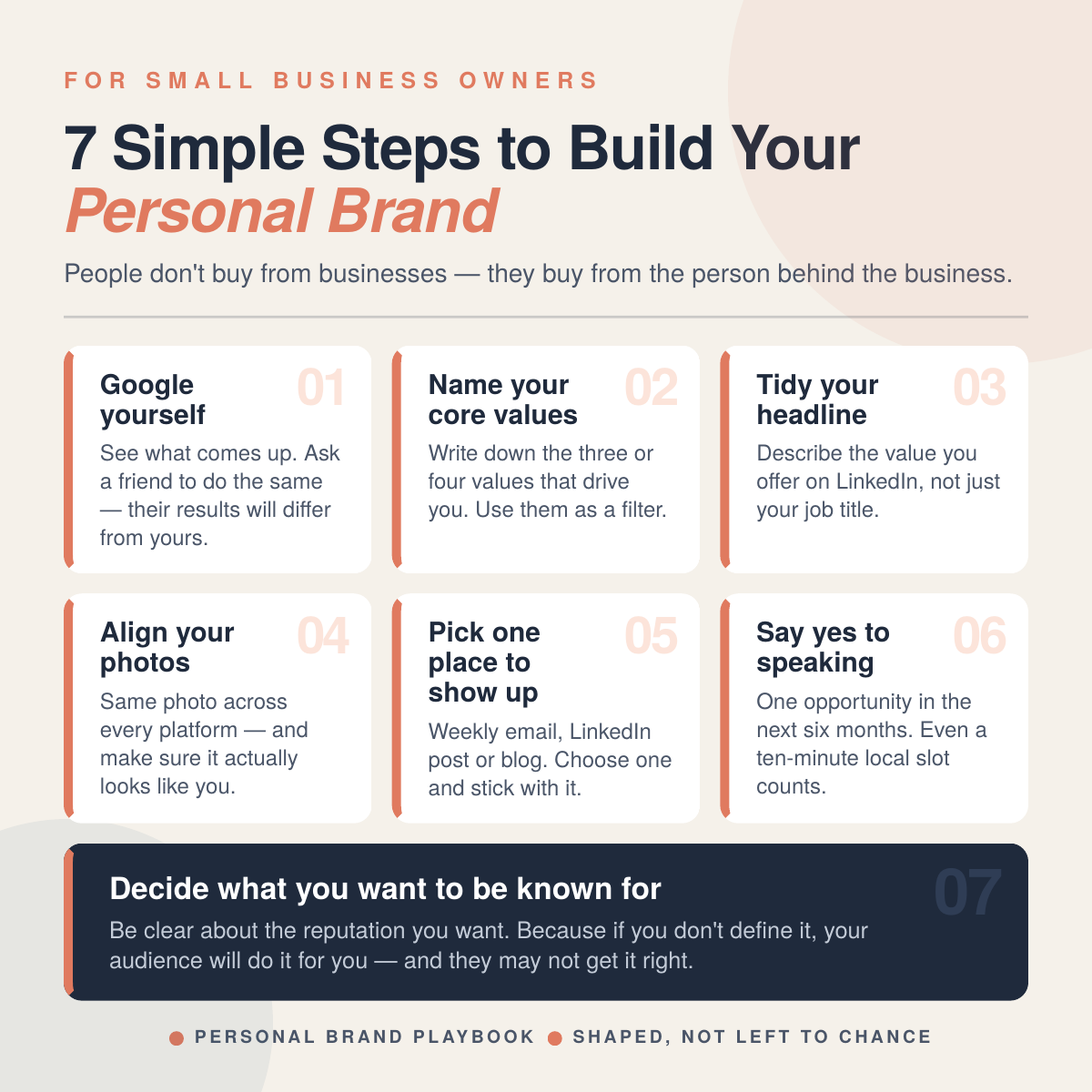
What Does Google Say About You?
People don't buy from businesses – they buy from the person behind the business. And in 2026, they're making up their minds long before you ever speak to them. Here's what the latest data says about building a personal brand as a service provider, plus seven simple steps you can take this week to shape how you show up.

The question isn’t which AI tool you should be using. It’s what are you trying to achieve.
Every AI tool being pitched to businesses right now is being sold on exactly the same promise. Efficiency. Do more with less. Cut the overhead. Automate the repetitive stuff. Reduce headcount.
And that's where it gets interesting — because efficiency is only one measure of value. And it's not always the most important one.
Earlier this Year LinkedIn Quietly Changed the Rules for New Zealand’s 3.35 million users.
Earlier this year, LinkedIn quietly replaced its entire content ranking system with a new AI algorithm — and most business owners have no idea it happened. If your posts have felt like they're disappearing into a void lately, this is almost certainly why.
Here's the thing: with 3.35 million New Zealanders now on LinkedIn — that's 63% of our entire population — the platform has never had a bigger, more business-ready audience. Your ideal clients are on there every week, in work mode, thinking about exactly the kind of help you provide. Ignoring LinkedIn right now would be a bit like opening a shop on the busiest street in town and forgetting to unlock the door.
The new algorithm is smarter, more selective, and it rewards businesses that understand how it works. The good news? Once you know what's changed, adapting isn't as hard as it sounds — and most of your competitors haven't bothered yet.
In this post, we break down the seven moves that are actually working on LinkedIn in 2026: from fixing your profile, to the content formats that get results, to turning followers into paying clients.
Read on — and download the free one-page infographic to keep handy.

Your marketing might be working. You just can't see it anymore. 👀
The business owners I worry about aren't the ones whose traffic is down. They're the ones who've quietly stopped posting, stopped updating their Google Business Profile, stopped asking for reviews — because they looked at their numbers and thought "what's the point?"
The point is that it's working. You just need different eyes to see it.

AEO: the marketing buzzword you actually need to care about 🤖
If SEO is about getting your website to show up in Google search results, AEO is about getting your business to show up in AI-generated answers. Think ChatGPT, Google's AI Overviews, Perplexity, and the growing list of tools people are now using to get answers without clicking on a single website.
That last bit is the important part.

My head is spinning (and not because of menopause)
My head is spinning (and not because of menopause)! Well it might be menopause, but the reality is A LOT is changing with how Kiwi business owners are marketing their businesses - and it’s a lot to keep up with.
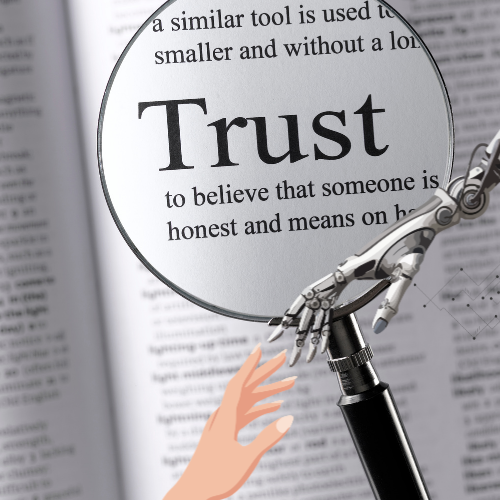
Building Brand Trust in the Age of AI
If you read my last blog, you’re probably already thinking about how you can make your brand more trustworthy. If you missed it, here’s a brief recap: AI is turning search behaviour on its head by presenting answers to prompts directly within the platform — no need to click on links or visit websites. We’ve all been watching this happen over the last couple of years and have been rushing to optimise our sites for this new age.
But things have gone one step further. Transactions are now taking place within AI platforms themselves — this happened in New Zealand for the first time last month. No visit to a beautifully branded, engaging user experience. No clicks at all. Welcome to zero-click commerce.
For an AI platform to serve up reliable, accurate information — and now, to facilitate a transaction on your behalf — it needs to be confident that your brand is trustworthy. So what signals is it actually looking for?